
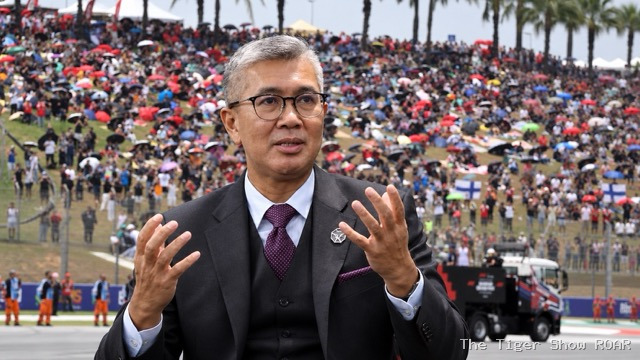
KUALA LUMPUR: The crowds came back. Across three days in early October, Sepang drew 261,000 attendances for a Formula One race few had expected Malaysia to host this year. It was a striking demonstration of the sport's appeal after a nine-year absence. What it did not establish was whether paying to stage the race every year would make economic sense.
The distinction has become central to the debate over a permanent return. Malaysia's ability to host a Grand Prix is no longer in doubt. Its capacity to justify the cost of a multi-year agreement remains unresolved.
Tengku Zafrul Tengku Abdul Aziz, senior political adviser to Prime Minister Datuk Seri Anwar Ibrahim, raised much the same question after attending the Singapore Grand Prix. In a post on X, he praised Singapore's ability to turn a race into a broader occasion for tourism, corporate meetings and high-end hospitality, and asked whether Malaysia could generate enough economic value to justify the expense.
His remarks were not an announcement of government policy. Tengku Zafrul no longer heads the Ministry of Investment, Trade and Industry, which he left in December 2025 and which is now held by Datuk Seri Johari Abdul Ghani. But they came as the Youth and Sports Ministry was preparing a feasibility assessment to put before the Cabinet.
A one-off bargain is not a long-term price
October's race cannot be used to estimate the cost of permanent hosting.
Formula One and the Federation Internationale de l'Automobile, FIA, confirmed on July 26 that Malaysia would join the 2026 calendar as the host venue for the Bahrain Grand Prix, with the race slotted at Sepang between the Azerbaijan and Singapore rounds. The confirmation said the agreement had been reached between Formula One, the FIA, the government of Bahrain and the government of Malaysia, subject to final agreements and approval by the World Motor Sport Council.
Formula One chief executive Stefano Domenicali said the organisation was delighted to confirm that Malaysia would host the Bahrain Grand Prix in 2026. FIA president Mohammed Ben Sulayem said he was proud of the collaboration that would enable the race to be held at Sepang.
Notably, the official announcement did not say who would bear the hosting costs. The race remained the Bahrain Grand Prix, and Bahrain remained the holder of the race rights.
According to a Hong Leong Investment Bank research note, Bahrain paid the hosting rights fee and retained ticket sales revenue. Malaysia's local preparation costs were put at about RM40 million, based on information from Sepang International Circuit chief executive Azhan Shafriman Hanif.
That arrangement will not necessarily be repeated. To secure a permanent slot, Malaysia would have to negotiate hosting rights, operating responsibilities and financial provisions within a multi-year contract.
In August 2025, then youth and sports minister Hannah Yeoh put the hosting fee at about RM300 million a year, with circuit maintenance at about RM10 million a year. She said Malaysia would have to bind itself to a three to five-year contract with Liberty Media, with the overall commitment estimated at about RM1.5 billion.
Azhan Shafriman said in July that annual costs would run to at least RM300 million once a rights fee of US$70 million to US$80 million and preparation costs were taken into account.
These are figures that have been stated publicly, not the terms of an agreed new contract. The real cost could shift with the length of the agreement, annual fee escalations, currency movements and the division of commercial rights.
The gap remains wide. RM40 million to prepare a replacement race is not a reasonable basis for estimating the price of hosting F1 permanently. The first was a one-off opportunity. The second is a long-term liability.
Singapore benefits, but how is that measured
Singapore is often cited as proof that Formula One can deliver large returns. Its official figures do show the event has economic value, but reading them is not as simple as comparing two sums of money.
In a written reply to Parliament on Feb 27, the Singapore government said a race-related levy had brought in an average of S$30 million per edition from 2022 to 2025. The annual cost of staging the race over the same period was estimated at S$140 million. From 2008 to 2024, the race was associated with more than S$2.2 billion in incremental tourism receipts.
Divided roughly across the some 15 editions held in that period, the tourism figure averages more than S$146 million per race.
That calculation is not a measure of profit. It sets tourism receipts accumulated over a long period against hosting costs drawn from recent years, when earlier costs were lower. Money that visitors spend at hotels, restaurants and shops also does not flow in full to the government or the promoter.
The S$2.2 billion in incremental tourism receipts is not net profit, not tax collected, and not a net fiscal return to the government.
In the same reply, the Singapore government stated plainly that it does not assess individual tourism events for their contribution to national gross domestic product. The spending is defended on the basis of wider economic and branding benefits, among them appeal to visitors, corporate gatherings, employment and international exposure.
All of that is relevant. None of it can be blended together as though it were cash profit from the race.
The question, then, is not whether Singapore benefits. It is what kind of benefit it receives, who receives it, and how much of it can be shown to come from Formula One.
Sepang has lost its crowds before
Malaysia has reason for caution. The previous run, which lasted from 1999 to 2017, ended as costs rose and attendance stopped meeting expectations.
Attendance at the 2016 edition was reported at 46,944. Ahead of the final race in 2017, grandstand tickets were still being sold at discounts of up to 82 per cent.
The SIC chief executive at the time, Datuk Razlan Razali, questioned the race's commercial appeal even on cheaper hosting terms.
"Even if we got the greatest of deals, do it for free for example, what's the product?" he told Reuters in 2017.
Former prime minister Datuk Seri Najib Razak ended the race from 2018, citing declining returns.
Attendance figures have to be read according to the definitions used in each year. The experience nonetheless serves as a reminder that interest in F1 does not move in only one direction.
A great deal has changed. Documentaries, digital coverage and new marketing strategies under Liberty Media have introduced Formula One to a younger generation of viewers. The response at Sepang in October suggests Malaysia has felt that shift too.
But a homecoming after nine years carries an excitement that annual editions may not reproduce. A five-year contract cannot be built on conclusions drawn from a single weekend.
A calendar slot does not simply go to the highest bidder
A further obstacle is the race schedule. Formula One does not intend to expand the number of events without limit, and Hannah Yeoh herself noted that the current calendar is very tight. A country seeking a place on it must compete with existing hosts as well as with others bidding for new slots.
Thailand has approved a plan worth about 40 billion baht to bring a street race to Bangkok from 2028 to 2032, according to its tourism minister, Sorawong Thienthong.
That figure cannot be compared directly with Malaysia's requirement, because Thailand has to build urban racing facilities while Sepang already has a permanent circuit.
The competition reveals something more important than construction costs, however. Hosting rights are now a commercial and diplomatic asset that several countries are pursuing at the same time. Having a world-class circuit gives Malaysia an infrastructure advantage, not a guarantee of a slot.
Do not set aside what MotoGP has achieved
In weighing F1, the government also has to account for the event already succeeding at Sepang.
The Malaysian MotoGP drew more than 190,000 visitors at its previous edition, and the Youth and Sports Ministry is targeting 200,000 for this year's race from Oct 30 to Nov 1.
Attendance alone does not prove that one event delivers a higher return than another. Ticket values, foreign visitor spending, sponsorship, operating costs and broadcast rights may differ considerably between the two championships.
The comparison matters all the same, so that a government decision is not driven by enthusiasm for a single global brand while overlooking a motorsport asset that has already built a solid market in Malaysia.
The question worth asking is how much additional benefit each ringgit of public spending on F1 would deliver against an equivalent investment in MotoGP, other championships, talent development or tourism promotion.
Before the Cabinet decides
Youth and Sports Minister Dr Mohammed Taufiq Johari said the assessment of hosting F1 would be based on facts, data and potential economic returns before any proposal went to the Cabinet. If hosting benefited the country, he said, the government would work towards it.
That is the right approach, but the strength of the study depends on what it measures.
First, direct revenue has to be separated from visitor spending. Ticketing, sponsorship, hospitality and related taxes are not the same as the total sum visitors spend across the country.
Second, economic spillover projections must be presented as projections until post-event data can confirm them. The RM345 million spillover to micro, small and medium enterprises cited by Entrepreneur Development and Cooperatives Minister Steven Sim Chee Keong rests on a projection that F1 spectators spend 2.17 times more than at ordinary events. The RM1.1 billion to RM1.3 billion projection from Hong Leong Investment Bank was issued in mid-September, before the race took place.
Third, assessors need to know how many visitors came specifically for F1 rather than having already planned a trip to Malaysia. The October race coincided with China's Golden Week holiday and the Visit Malaysia 2026 campaign. Without accounting for visitors who would have come anyway, the race's additional benefit is easily overstated.
Fourth, the full public cost has to be counted. Beyond the hosting fee there is spending on security, transport, health, maintenance, inter-agency coordination and manpower, including the thousands of volunteers Prime Minister Datuk Seri Anwar Ibrahim thanked in his Budget 2027 speech.
Harder to measure, but no less necessary, is the opportunity cost. What other projects would be deferred if funding on that scale were committed to F1?
Finally, the study would need to set out several scenarios, among them falling attendance after the first season, rising fees and a currency moving against Malaysia. A sound decision is one that still holds when the real numbers fall short of the most optimistic forecast.
A lively track, but is it worth it for the country
There is no doubt that Formula One's return to Sepang has revived the enthusiasm of fans and shown that Malaysia can manage an international race under unusual conditions. That achievement deserves recognition.
But a lively atmosphere and sound spending policy are two different things. Formula One may deliver tourism benefits, business opportunities and publicity that are difficult to obtain through other channels. It may also cost far more than the additional returns that can be demonstrated.
The government need not reject F1 simply because it is expensive. Nor should it accept it simply because 261,000 attendances created a picture of success.
Before a new contract is signed, the public is entitled to a transparent comparison of full costs, testable additional benefits and alternative uses of the money.
That is where the real test of Formula One's return lies. Not in how fast the cars circle Sepang, but in how carefully the country decides once the cheering has died down.
← Kembali ke halaman utama