
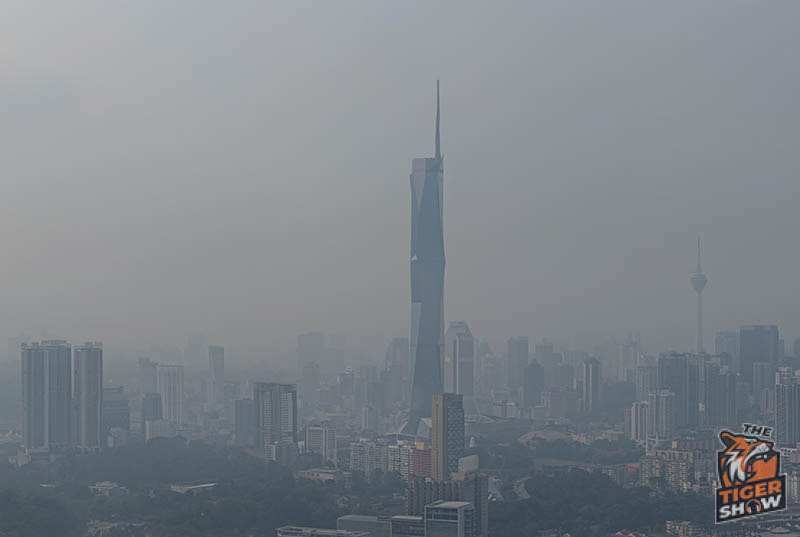
A monitoring station at the Serian district police headquarters recorded an Air Pollutant Index reading of 519 at 3:50 p.m. on Sept. 4, the highest in the country at the time.
That crossed the 500 mark, the level that has long served as the basis for considering a haze emergency in Malaysia.
By comparison, Muar, in the southern state of Johor, recorded a reading of 746 at 7 a.m. on June 23, 2013, and Kuching was reported to have reached 839 in September 1997. The Kuching figure remains the highest ever recorded in the country.
Four emergencies in 29 years
According to a chronology of haze episodes published by the Department of Environment, the first emergency was declared in the Kuching area from Sept. 19 to Sept. 28, 1997, after the index passed 500.
That crisis was driven by large forest and peatland fires in Kalimantan and Sumatra, worsened by unusually dry weather brought on by El Nino. News accounts put the peak reading in Kuching at 839, while some records cite a figure closer to 860.
Eight years later the peninsula's turn came. On Aug. 10, 2005, Port Klang recorded 424 and Kuala Selangor 418. The next day both areas passed 500, and Abdullah Ahmad Badawi, then the prime minister, declared an emergency on Aug. 11.
Port Klang, the country's busiest harbor, was shut along with schools, government and private offices, factories and construction sites. Supermarkets, pharmacies and essential services stayed open. The emergency was lifted on Aug. 13 as air quality improved.
The peninsula's highest reading came in 2013, when Muar registered 746, more than twice the hazardous threshold, according to the Department of Environment as reported by The Star. Najib Razak, then the prime minister, declared an emergency in Muar and Ledang the same day. It was lifted on June 24 once the index fell below 300.
Two days after that, on the morning of June 25, Port Klang recorded 487, close to the emergency level again.
Serian, 2026: 647 schools closed
In Serian, the emergency was declared on Sept. 4 after the reading reached 519. A total of 647 schools were closed, and government and private offices, plantations, construction sites and quarries suspended operations, with only essential services allowed to run.
Cloud-seeding flights began on Thursday and were extended after forecasts pointed to favorable atmospheric conditions.
On the same day, Kuching recorded 313, Samarahan 284 and Sri Aman 236. Under the Malaysian index, readings above 300 are classified as hazardous and those from 201 to 300 as very unhealthy.
Sultan Ibrahim, Malaysia's king, consented to ending the emergency on Sept. 7 on the advice of Prime Minister Anwar Ibrahim and the Sarawak premier, Abang Johari Tun Openg, after readings in the Serian Division were no longer at hazardous levels. The announcement came through the prime minister's office.
Air quality in nearby areas, including Samarahan, remained very unhealthy when the emergency ended.
Two records, two regions
Malaysia's haze records are, in effect, two separate regional stories.
In Sarawak, the highest reading is the 839 recorded in Kuching in 1997, followed by the 519 in Serian this year. On the peninsula, the peak is the 746 in Muar in 2013, followed by the readings above 500 in Port Klang and Kuala Selangor in 2005.
The current episode has spared the peninsula those extremes. Most areas in Selangor, Kuala Lumpur and Johor stayed in the unhealthy band of 101 to 200 through August and early September.
The cause has changed little in three decades: forest and peatland fires in Kalimantan and Sumatra. The transboundary smoke has also reached Sabah, Brunei and Singapore, and in the Philippines it forced the suspension of classes in Metro Manila and more than a dozen provinces.
← Kembali ke halaman utama