
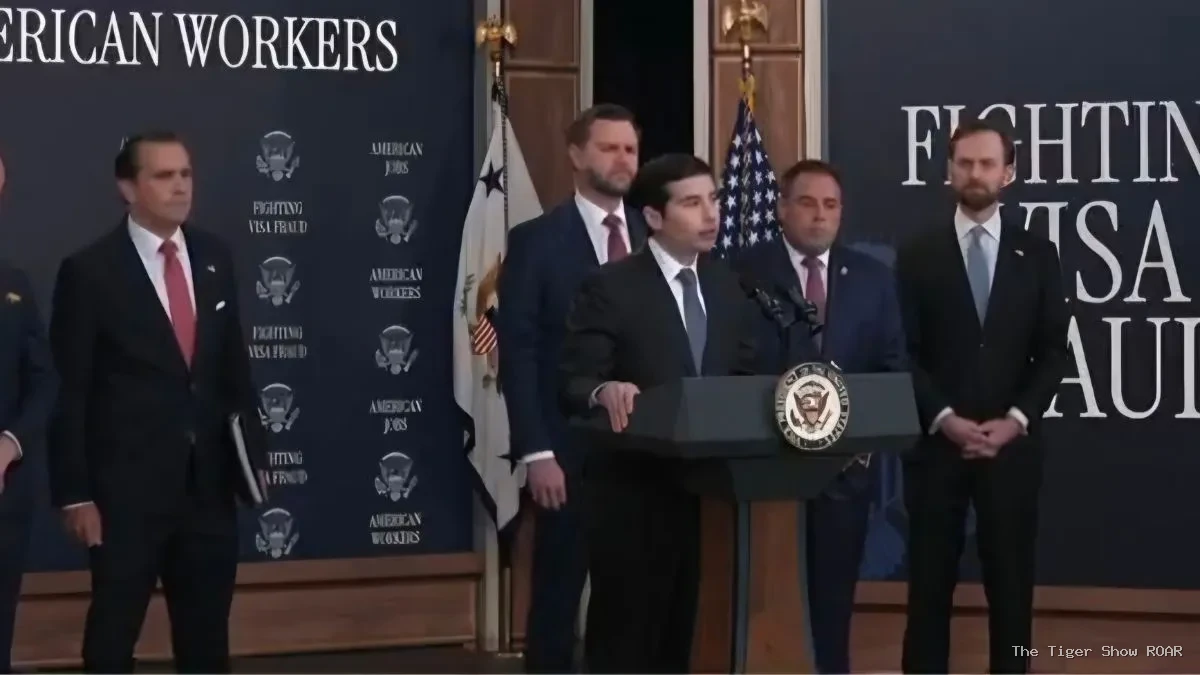
WASHINGTON: The United States has suspended eight technology and outsourcing companies from the labour certification programme used to sponsor foreign employees for permanent residency, in the Trump administration's latest move against employment-based immigration programmes.
The action, announced on Thursday, covers Microsoft, Adobe, Cognizant, Infosys, Tata Consultancy Services, Wipro, HCL Technologies and Capgemini.
Labour Secretary Keith Sonderling said his department would stop accepting new applications and halt processing of pending cases involving those employers under the Permanent Labor Certification programme, known as PERM.
The announcement cited several active federal investigations without detailing them.
What PERM is
PERM is a certification process run by the Labour Department that employers must complete for most employment-based green card applications.
An employer has to show that hiring a foreign worker will not undermine the wages or job opportunities of American workers for the position concerned.
PERM is not the H-1B visa, and certification is not itself the grant of a green card. It is an earlier stage that must be cleared before a permanent residency application is filed.
What it means for workers
The suspension means employees of the affected companies who have yet to begin an application cannot proceed through their employer, while those whose cases are pending face a delay with no set end date.
The consequences could be heavier for H-1B holders approaching the six-year limit usually associated with that status. In certain circumstances, progress on an employment-based permanent residency application can help a worker qualify for an extension.
The suspension is not a blanket cancellation of H-1B visas, nor an order to deport the companies' foreign employees. Workers who hold valid immigration status do not lose their authorisation to work or remain in the United States simply because their employer's PERM applications have been halted.
Federal officials have not said how many workers are directly affected or what the decision means for certifications already approved.
Vance singles out Microsoft
Vice-President JD Vance defended the move as a measure to protect American jobs, and directed his sharpest criticism at Microsoft.
"Our message to Microsoft is: You're a great American company, but you've got to hire great American workers," he said.
Vance said no US company had abused the system more than Microsoft, and that the company had laid off 6,000 American workers last year while benefiting from 6,300 H-1B visas and nearly 3,000 green cards.
Those figures are Vance's own claims. Microsoft announced in July that it would cut 4,800 jobs, about 2.1 per cent of its global workforce.
Vance said the suspensions would remain in place as long as needed, with the administration wanting the companies to change their hiring practices.
Microsoft's response
Microsoft defended its hiring practices, saying it pays H-1B employees the same as others doing comparable work.
The company said about 80 per cent of its H-1B filings in the last fiscal year were extensions or changes of status for existing employees rather than new hires from overseas.
University investigations
In the same announcement, the administration said nine universities were under investigation over the alleged misuse of exchange visitor visas, among them Harvard, Yale, Stanford, Brown and MIT.
Labour Department Inspector General Anthony D'Esposito said subpoenas had been served and that investigators would examine foreign influence, improper financial relationships and visa abuse.
No findings of wrongdoing have been reported at this stage, against either the companies or the universities named. Suspension from the PERM programme is an administrative action and not a court ruling establishing fraud.
← Kembali ke halaman utama